Escape the Middle Class in 2025: Why Most Are Falling Behind and How You Can Get Ahead
The middle class in the U.S. has been shrinking for decades. Back in the early 1980s, about 61% of Americans were considered middle class. Today, that number has dropped to around 52%.
Now, you might be thinking: “Wait, Moses—your title says escape the middle class. If fewer people are middle class, doesn’t that mean they’re already escaping?”
Ohh, yeah, yeah… but here’s the truth: most people aren’t moving up into wealth. They’re sliding down into poverty. That’s why I’m writing this article.
In this post, I’ll break down what the middle class and poor often do wrong compared to the wealthy—and how you can change course. To make it super clear, I’ll even show you two simple bar graphs that compare their habits side by side.
What Is Income?
The money you make or that your assets produce for you is known as income.
This money is either saved or used for expenses.
Income = Expenditure + Savings
Savings are divided into two main types:
1. Cash savings: Money kept in your bank account, emergency fund, or low-interest deposits.
2. Asset savings: Money invested in assets like stocks, real estate, or business.
Therefore, you either spend or save every dollar you make. How you divide your income between these two categories decides whether you stay in the middle class or move toward becoming rich.
How the Middle Class Spends vs. How the Rich Spend
When you take a closer look at spending, the difference between the middle class and the wealthy becomes very clear.
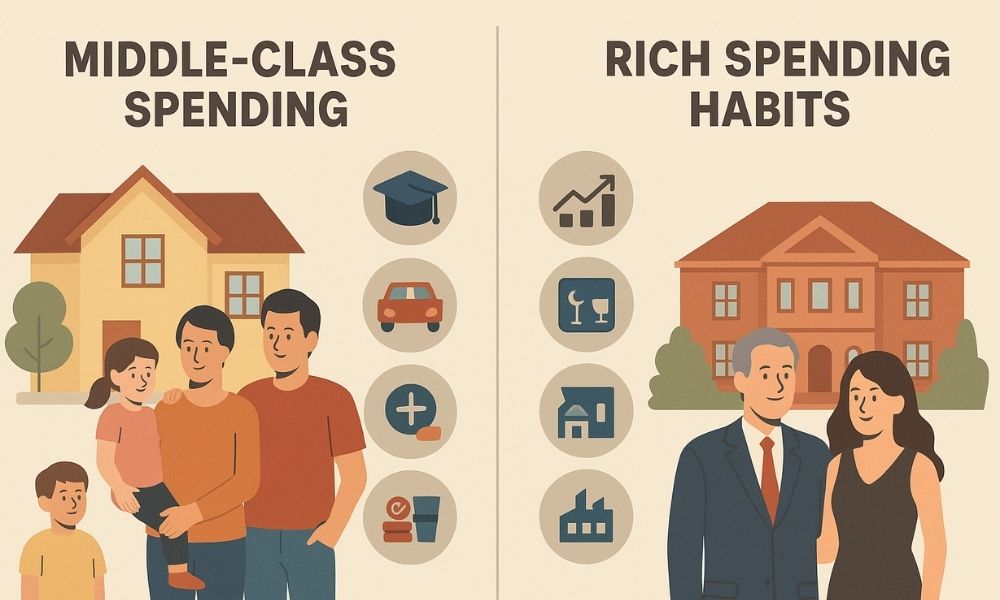
Middle-Class Spending
Housing takes the biggest share of middle-class income. According to CBS News, many families spend around 30% of what they earn just on rent or mortgage.
Education and childcare come next, taking about 20% of income combined. These are essential, but they often leave little room for saving.
Then comes transportation, lifestyle, and all those small subscriptions that quietly eat up a good part of your money each month.
Entertainment still finds a place in the budget — dinners, movies, and short trips — because everyone needs a break.
A small part of income also goes toward health insurance, which has become more of a necessity than an option today.
Rich Spending Habits
For the rich, housing and food take up only a small part of their income, even though they live in big houses and enjoy a good lifestyle. Their income is much higher, so basic expenses barely affect them.
They spend very little on lifestyle, transportation, and entertainment compared to what they earn. Their main goal is to grow their money, not to show it off.
The majority of their earnings are invested in stocks, real estate, and companies that gradually increase their wealth.
Take Warren Buffett for example. He still lives in the same house he bought years ago, even though he’s one of the richest people in the world.
How the Middle Class Saves vs. How the Rich Save
After covering all expenses, the real difference shows up in how people save their money.
There are two types of savings:
1. Cash savings: Money saved in banks, deposits, or emergency funds.
2. Asset savings: Money invested in stocks, businesses, real estate, or retirement plans.
How much you put into each of these decides whether your money simply stays safe or starts growing for you.
Middle-Class Saving Habits
After covering all essential expenses, very little is left for investments. The middle class is structured in a way that keeps people living paycheck to paycheck. You can check my article “10 Proven Ways to Escape the Paycheck Lifestyle” to learn how to break out of it.
Most middle-class families see their home as an asset, but in reality, it’s a liability — it doesn’t bring in income and still needs maintenance and taxes.
A small portion of their savings goes into stocks, usually safe ones like the S&P 500, while the majority goes into retirement funds, insurance policies, and bank deposits.
The problem is, these investments don’t generate passive income or grow fast enough to create financial freedom.
Rich Saving Habits
After covering their expenses, the rich still have a good amount left to invest because their income is much higher.
Most wealthy people invest in real estate like apartments, commercial spaces, or farmland, which brings them regular passive income.
They also invest a big portion of their money in stocks, and many of them fund new or small startups that can grow their net worth quickly. Of course, these come with risks — but the rich understand that smart risks often lead to big rewards.
You might wonder, do they keep cash too? Yes, they do. Rich people always keep some cash on hand because they never know when the next opportunity will appear. When it does, they’re ready to invest immediately.
Why the Middle Class Struggles to Save Like the Rich
There are many reasons middle class cannot able to save like rich. One of the reason is system won’t let them to do so. And the second they themselves don’t let them to do so.
Below are the some reasons for this.
1.Wage stagnation vs rising costs.
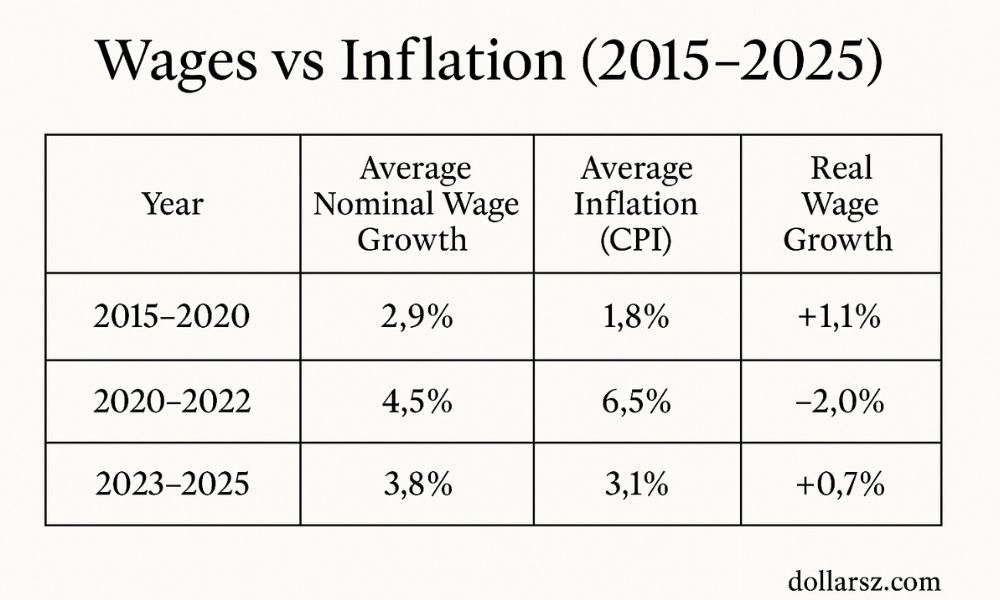
Even if your paycheck has gone up a little, you might still feel like nothing’s changed—or even worse. That’s because of wage stagnation, where your income isn’t growing fast enough to keep up with rising prices. The cost of everything—housing, groceries, insurance—keeps climbing, while your wage growth falls behind.
Take a look at the table below to see how this gap has widened over the years.
2.Shift in the Job Market
Traditional jobs are slowly being taken over by machines. With the rise of AI, even many skilled software professionals have lost their jobs—not because they lacked talent, but because AI can do the same work faster and at a much lower cost.
The focus of the job market is changing. Tech jobs are being replaced by technical jobs. The demand for skilled trades like plumbers, electricians, and mechanics is growing, while many white-collar roles are shrinking. It’s a clear reminder that the future belongs to those who can adapt and learn new, in-demand skills.
3.Decline of Unions
Unions once stood strong for workers, fighting for fair pay and better conditions. But since the 1970s, their presence has slowly faded. As unions weakened, workers lost the power to negotiate with employers. Over time, wages stopped growing, and many of the benefits that once protected workers began to disappear.
4.The Debt Trap
Credit card bills, student loans, mortgages, and medical expenses are swallowing a big part of middle-class income. Most of what they earn goes straight into paying off debt, leaving little to save or invest. And without savings or investments, they stay stuck in the same middle-class trap — working hard but never really moving forward.
5.Policy and Tax Changes
Tax breaks for the wealthy, reduced government support, and lower investment in housing, healthcare, and education have made life tougher for the middle class. The safety net that once protected working families is slowly disappearing.
6.Skill Mismatches and Education Gaps
Many middle-class workers lack the skills needed for the high-paying jobs of today. Old degrees and experience are no longer sufficient due to the rapid advancement of technology. They become trapped in low-paying jobs with little room for advancement if they don’t retrain or acquire new skills.
7.Changes in Demographics
More people are living alone as the population ages. Generally speaking, single-person households make less money, which weakens the middle class’s overall financial position. Slower economic growth and lower spending are also consequences of fewer earners.
8.Decline Mobility of the Economy
It is now more difficult than ever for most families to move up the ladder. Wages haven’t kept up with the ongoing price increases. While the middle class finds it difficult to keep up with the necessities of life, the wealthy continue to amass wealth through stocks and real estate.
How to Get Out of the Middle-Class Trap
Before getting into the strategies, I want to share a conversation I had with my grandpa a few years ago that changed the way I think about money.
He said, “I used to go to work, and your grandma stayed home to take care of your father. Even though I was the only one earning, we lived happily. From that income, I always saved for emergencies, invested, and even bought two houses.”
Then he looked at me and said, “But your parents are both earning, yet they still struggle to make both ends meet.”
That made me think deeply. Why are most people stuck in the middle class even though we earn more than before? After researching, I found out that the system actually wants us to stay middle class and broke.
While trying to escape this cycle, I met an accountant named Kevin. He taught me about tax loopholes and how to build wealth slowly but surely. I want to share those things with you.
1. Financial calendar
A financial calendar is where you plan every money move you want to make in a year.
You note down your bill due dates, investment days, savings goals, and tax deadlines all in one place.
It helps you stay disciplined with your money habits, so you never miss an important financial step.
2. Financial Template
After setting up your financial calendar, the next step is to create your financial template.
A financial template is a simple sheet where you note down all your income, expenses, savings, and investments in one place.
You can make it in Google Sheets, but I personally suggest printing it out and writing everything by hand.
Writing things on paper may look old-fashioned, but it makes you more connected and serious about your money. I’ve experienced this myself.
3. Building Multiple Income Sources
With just one paycheck, it’s almost impossible to escape the middle-class trap unless you suddenly come into a large amount of money.
These days, most companies pay you just enough to cover your basic expenses — nothing more. That’s how the system keeps you stuck.
If you really want to move ahead, you need to build multiple income sources. Start small, but start somewhere. Each extra stream of income gives you more freedom and less stress.
I’ve written a few articles that can help you get started with building passive income. Take a look at them — they might give you the direction you need.
- YouTube Automation Made Simple: Earn from Home Without Showing Your Face in 2025
- 9 Legit Ways to Make Money Online in 2025 (That Actually Work)
- iPhone Reselling Made Simple: Turn $300 into $1,000 in a Week
4. Starting a Business
Kevin once told me, “You’ll never escape the middle class if you keep thinking like an employee.”
Starting a business doesn’t mean you need a big office or a huge team. It can be something simple — like an online store, a digital product, or a small consulting service.
The main idea is ownership. When you own something, your money starts working for you instead of just working for your boss. That’s how real financial freedom begins.
If you’re looking for ideas to start an online business, you might check the article below — it will help you find the right direction to begin.
21 low-cost home business ideas for moms(Start with $100 or Less)
5. Tax Loopholes and Planning
The wealthy handle taxes in a completely different way.
Kevin showed me how simple legal strategies — like using deductions, business expenses, and investment benefits — can help you keep more of what you earn.
The truth is, the middle class pays the most in taxes because they don’t know how the system works. The wealthy, on the other hand, learn the rules and use them smartly to their advantage — all legally.
6. Investing in Farmland
One of the most surprising things I learned from Kevin was about investing in farmland.
Unlike stocks that keep jumping up and down, farmland grows slowly in value while also giving you steady income every year. It’s one of those quiet wealth secrets that most billionaires know but rarely talk about.
If you want to understand why farmland is a smart and stable investment, I’ve written a detailed article about it — make sure to check it out.
Conclusion
The middle class isn’t shrinking because people don’t work hard—it’s shrinking because the system has changed. Wages haven’t kept up, debts are heavier, and old job security has disappeared. But that doesn’t mean you’re stuck.
Escaping the middle class in 2025 comes down to choices: spend less on consumption, save with intention, and invest in assets that grow. Use a financial calendar, build multiple income streams, think like a business owner, and put your money where it works for you—not against you.
The middle-class trap isn’t permanent. With structure, strategy, and consistency, anyone can step out of survival mode and move toward lasting wealth.